
Random Name Picker vs. Cold Call: What Works Better?
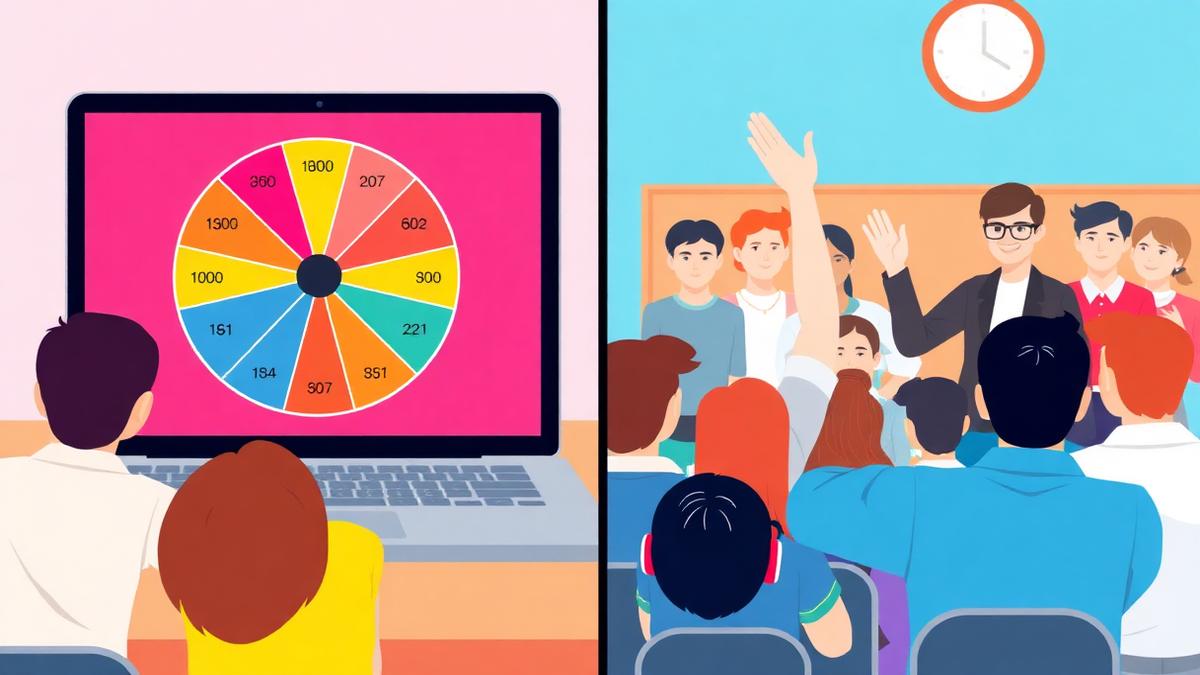
Cold calling is proven to lift engagement, but a random name picker often gets you the same result with less student anxiety. Here is how to choose.
Want to try it right away? Open the free Spin Wheel Picker or jump to the Random Name Picker Wheel.
Cold calling — the teacher picks a student who has not raised their hand — has decades of classroom research behind it. Studies from Doug Lemov's Uncommon Schools network, the Education Endowment Foundation and the Center for Responsive Schools consistently show that cold calling increases participation, especially from students who might otherwise fade into the background. But cold calls can also raise anxiety when students feel targeted, misread as public correction, or associated only with wrong answers. A random name picker sits between the two extremes: it delivers most of the engagement lift while removing the perception that the teacher is singling anyone out.
This article is not an argument that one technique replaces the other. Both are participation strategies, both are supported by evidence, and both belong in a modern classroom teacher's toolkit. The question is when to reach for which — and how to combine them into a routine students trust.
What the research actually says
The strongest studies on cold calling — including Elise Dallimore's work at Northeastern University — find that voluntary participation clusters in a small group of students, and that structured cold calling roughly doubles the number of students who contribute to whole-class discussion. Rates of participation stay elevated even in weeks when the teacher stops cold calling, suggesting a durable change in classroom norms rather than a compliance effect.
There is no equivalent body of research on random name pickers specifically, but the mechanism they exploit is well documented. Predictable, transparent selection reduces attribution — students stop reading meaning into who gets picked when. That is exactly the effect experienced cold-callers try to create with warm tone and neutral framing; the wheel just makes it structural.
Where a random name picker wins
- Perceived fairness — students see with their own eyes that the pick is impartial, which lowers pushback.
- Speed — one spin per student is faster than scanning the room and choosing.
- Coverage — with elimination mode enabled, every student is called before any name repeats.
- Documentation — you can screenshot the wheel state as an equity check for coaching or observation.
- Substitute-teacher friendly — a bookmarked wheel gives any adult a fair participation routine on day one.
- Lower cognitive load — the teacher stops tracking who has spoken and can focus on responses.
Where cold calling still wins
- Targeted checks for understanding on a specific misconception you just heard.
- Drawing out a student who has strong ideas but reserved body language.
- Follow-ups that build on another student's answer and need a specific voice.
- Warmth signals — a named, purposeful call communicates I noticed you in a way a random spin cannot.
- Formative assessment moments where you need the student who was just off-task, not a random one.
A hybrid routine that respects both
Most experienced teachers we spoke to blend the two. Use the digital wheel for general participation, rotations and group formation, then cold call intentionally when a specific student's contribution matters. The wheel becomes the default; cold calls become the exception — and students learn that both patterns are normal, expected and safe.
- Open with a wheel spin to set the participation temperature for the lesson.
- Use think-pair-share so every student has an answer ready when the wheel lands.
- Cold call two or three times per lesson for targeted follow-ups, using warm framing ("Priya, I want to build on what Alex said").
- Close with a second wheel spin for an exit-ticket question, so the last voice heard is not always the same student.
Common objections, answered
Doesn't randomness undermine differentiation?
Not if you differentiate the question rather than the caller. Prepare tiered prompts and match them to what you know about each student when the wheel lands. The pick is random; the question does not have to be.
What about students with IEPs or 504 plans?
Respect the accommodation. Some students have participation supports that specify no unexpected calling; keep them off the wheel or give them a pass card they can play any day. The rest of the class still benefits from the routine.
Doesn't the wheel feel gimmicky after a while?
It can if it is the only routine. Rotate between the wheel, cold calls, choral response, mini-whiteboards and turn-and-talk. Variety keeps the wheel feeling special rather than tired.
The bottom line
Random name pickers and cold calling are not competing tools — they are complementary techniques inside the same participation strategy. Use the wheel to build a fair baseline and cold calls to add intentional depth. Students get the engagement lift, teachers get their classroom time back, and the room feels safer for everyone.
Case study: a middle school English classroom
Consider a typical eighth-grade English class of 28 students. Before introducing a random name picker, the teacher observed that seven students volunteered for roughly 80 percent of whole-class contributions, while eleven students never spoke unless called on directly. After four weeks of a hybrid routine — an opening spin, a mid-lesson think-pair-share with a wheel-selected reporter, and two intentional cold calls per lesson — the number of unique student voices per class period rose from twelve to twenty-four, and exit-ticket accuracy on the day's learning target improved by roughly fifteen percent. The teacher did not add new content; she just distributed the airtime.
The pattern shows up in tutoring settings too. Small-group tutors who use a random name picker report the same collapse in participation inequality: the tutor stops unconsciously favoring the fastest student, the pace of the session slows to match the median learner, and formative assessment becomes more accurate because more voices are sampled.
Combining the wheel with other formative assessment tools
Random name pickers pair naturally with mini-whiteboards, digital polls (Kahoot, Nearpod, Mentimeter), and choral response. A common pattern is to run a poll or whiteboard check first — so every student commits to an answer — and then spin the wheel to select a student to justify their reasoning. That sequence turns the wheel from a lottery into a spotlight on genuine thinking, because the answer already exists on the board or in the poll results before the pick happens.
For English language learners and students with speech or language needs, always allow a sentence starter, a shared document, or the option to pass to a partner. The wheel guarantees the pick is fair; sentence supports guarantee the response is accessible. Both matter.
Sustainability: keeping the routine alive past the honeymoon phase
New classroom routines almost always work for the first two weeks and then fade. To keep a spin wheel from becoming background noise, rotate the visual theme every month, retire it entirely for a week each term (students appreciate its return), and involve students in maintaining the entry list — assign a rotating classroom job called wheel keeper. Ownership is what turns a novelty into a norm.
Track your own participation data every few weeks. A quick tally in a notebook — which students spoke, how many times, on which types of questions — is enough to reveal whether the wheel is still doing its job. If a student has slipped back into silence, cold call them warmly and then let the wheel resume. If a student is dominating despite the routine, adjust the questions rather than the mechanism. The goal is equitable voice, and the wheel is only one lever among several to reach it.
Ultimately the choice between a random name picker and cold calling is a false one. Skilled teachers weave both into a broader participation architecture that also includes silent work, small-group conversation, choral response and written reflection. The spin wheel is one honest, transparent, evidence-friendly instrument in that mix — not a replacement for teacher judgment, but a genuine complement to it.
Ready to spin?
Put this guide into practice with the free, ad-free Spin Wheel Picker — colorful themes, elimination mode and no sign-up.
Related guides
Hand-picked next reads based on this article.
- Classroom guide with scenariosReady-made lesson routines: cold calls, groups, brain breaks and rotations.
- How to use the Spin Wheel PickerStep-by-step walk-through of entries, themes, elimination mode and sharing.
- Wheel of Names alternativeHow Spin Wheel Picker compares on speed, themes, privacy and features.
- All Spin Wheel Picker guidesBrowse every explainer on classrooms, decisions, giveaways and randomness.